


 Edificio CIBA
Avda. San Juan Bosco, 13
50009 Zaragoza






The ECHO Project has its origins in the year 2002 in Spain with the Atlas VPM Project. This project was a nationwide Health Services Research (HSR) Program concerning the analysis of unwarranted variations in medical practice and healthcare outcomes in Spain. The idea was to compare healthcare geographically – region by region – with a view to giving powerful feedback to policy decision-makers and managers nationwide.
Given the experience with overcoming the technical and administrative hurdles associated with such a project – and also give the clear benefits quickly gained by the participating health authorities; a decision was made to repeat the project on a European scale. This was the origin of the ECHO project – an effort to bring together national hospital databases of several European countries.
 Project Coordinator
Enrique Bernal-Delgado MD PhD
Senior Health Services and Policy Researcher
Data Science for Health Services and Policy Research Group
Institute for Health Sciences. IACS
FundingThe ECHO Project received funding from the 7th Framework Programme of the European Union (2010-2014) and from the Health Programme of the European Union (2015-2017)
ECHO aimed at building a common knowledge infrastructure, based on existing datasets, which ultimately allowed international healthcare performance comparisons. Conceived as a pilot study, ECHO set about the task of bringing together patient-level data from Denmark, England, Portugal, Slovenia and Spain, as well as, contextual information -demographic, socioeconomic, and healthcare supply data.
This knowledge infrastructure allows the evaluation of more than 40 performance indicators, carefully developed to avoid inappropriate cross-country comparisons. The ECHO knowledge infrastructure allows the study of several performance dimensions (equity, effectiveness, safety and efficiency) at international, national, regional, and even provider level.
The ECHO pilot knowledge infrastructure has proven to be a powerful tool in the assessment of Healthcare Systems Performance across Europe, upgrading the existing experiences and tools on international comparison. Adding more EU countries to the current infrastructure and thus meeting the growing demand for smarter international comparison requires specific EU funding.
ECHO findings have informed decision-makers about in- and cross-country differences in equitable access to healthcare services, uneven effectiveness, quality and safety, and unequal efficiency.
In the context of Bridge-Health, the ECHO principles and methods continued providing insight on how to use administrative data sources in the development of a European Health Information System. The Joint Action InfAct showcasing how to reuse real world data in the systematic analysis of the European Healthcare Systems.
InfAct, who expands Bridge Health achievements, focus on developing the business case and roadmap for the implementation of such a European research infrastructure where the definition and implementation of interoperability principles is paramount.
It is precisely in getting interoperability issues properly solved in the infrastructure where ECHO foreground is serving as the basis for inspiration and development.
The ECHO project e-Handbook aims at describing the methods used in the construction of the ECHO Atlas Reports.
Definition used in the Atlas Reports.
This report aims at describing, systematically and in detail, all the steps involved in the construction of the DWH.
Papers derived from ECHO project: www.cienciadedatosysalud.org/tipo-publicacion/echo/
Comparison between Denmark, Slovenia and Spain
In conjuction with Oxford University Press ECHO has published a supplement in the European Journal of Public Health Volume 25, Issue suppl 1, 01 February 2015: ‘Unwarranted variations in health care performance across Europe: Lessons from the ECHO Project‘, including a number of papers reflecting the work done by ECHO
Atlas Num.3 on Coronary revascularisation Mortality and morbidity from cardiovascular disease are considered a public health issue. In fact, coronary ischaemic disease is one of the leading causes of death in Europe.
The study offers a critical view on how healthcare organizations provide care to patients with chronic conditions. In particular, it signals how effectively they are managed in the ambulatory setting.
Health Systems bear substantial opportunity costs by using interventions that are deemed lower-value. Quantifying the utilisation of this type of care and its systematic variation across policy-relevant geographical units offers insight at a glance into the local potential for enhancing efficiency.
ECHO Steering Committee and ECHO Scientific Advisory Board (SAB) representatives
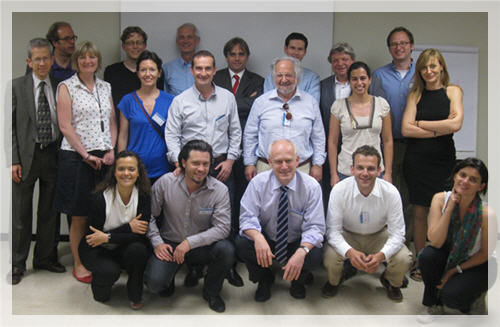
Membership of the Scientific Advisory Board (SAB)
The role of the SAB was to advise the ECHO Steering Commitee on the quality of the deliverables of the project, ethical issues, general philosophy and direction of the ECHO project.
The project consortium counted with the expertise of:
Josep Figueres. Director of the European Observatory for health Systems
Eliot S Fisher. Director of Centre for Health Policy Resercha DMS
Alberto Holly. Laussane University
Edward Keley. OMS World Alliance for Patient Safety
Niek Klacinga. Coordinator of OECD HCQI Project
Guillem López-Casanovas. International Health Economic Association
Patrick Romano. University of UC-Davis AHRQ Commissioned Researcher
Klim McPherson. Oxford University
Dirk Van den Stten. European Commission DG SANCO
Edificio CIBA
Avda. San Juan Bosco, 13
50009 Zaragoza